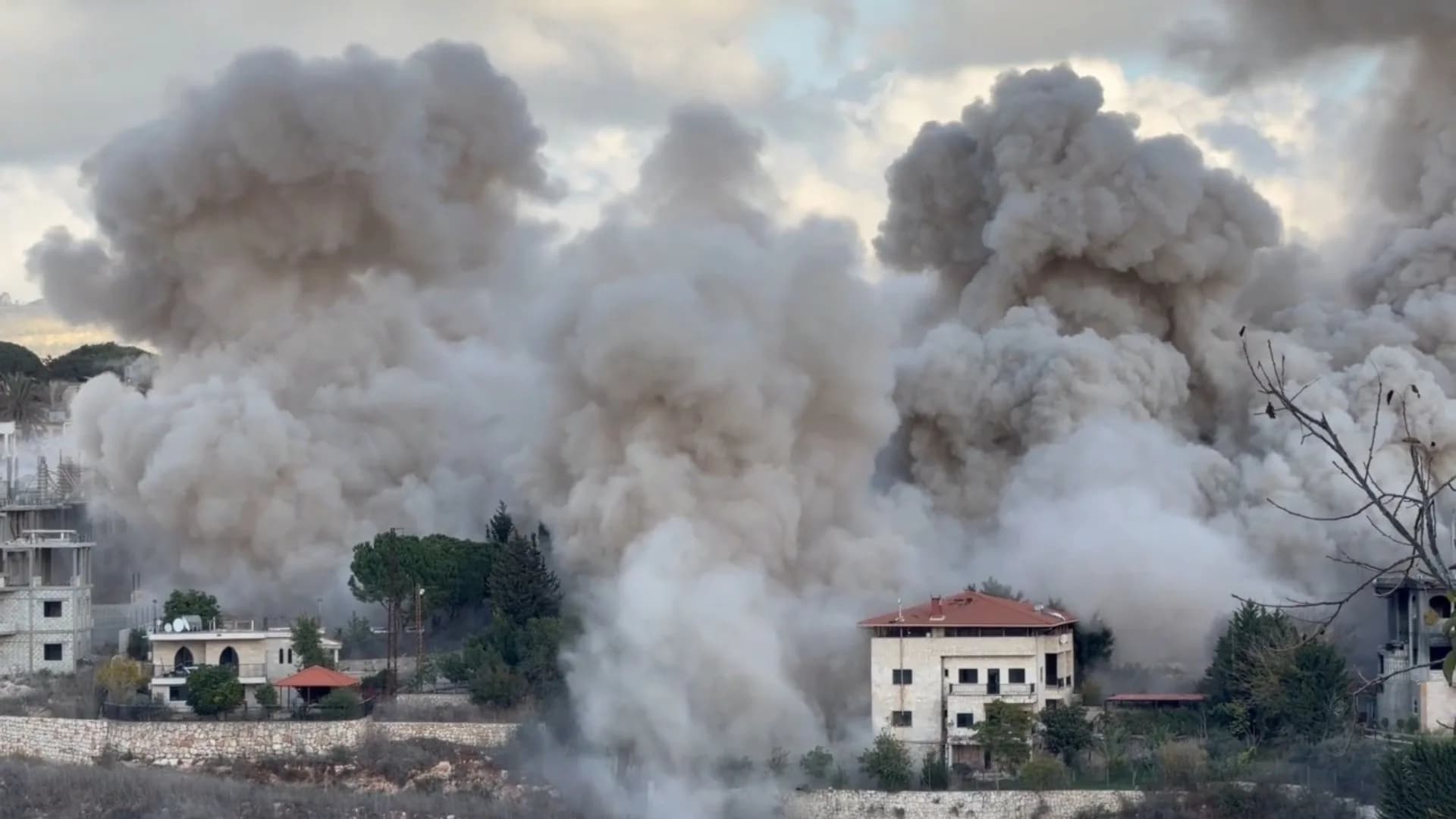
Israeli forces set off large explosions in three villages in southern Lebanon on Sunday, 22 November, destroying homes and sending thick columns of smoke over residential areas, Lebanon's National News Agency reported. The blasts struck Zawtar al-Sharqiyah and Kfar Tibnit in the Nabatieh district, and the outskirts of Qantara in the Marjayoun district, on the day Lebanon marked its Independence Day.
The National News Agency said Israeli forces detonated explosives to destroy structures on the outskirts of Qantara, after setting off a massive explosion in Zawtar al-Sharqiyah earlier on Sunday, followed by another in Kfar Tibnit.
No casualty figures were reported in the accounts available at the time of writing. The Israeli military has said its forces continue to operate in southern Lebanon. It had issued no public comment on Sunday's blasts at the time of reporting.
What the Footage Shows
Footage from the area shows a blast sending a thick cloud of smoke above Zawtar al-Sharqiyah, with columns of smoke rising over Kfar Tibnit and Qantara. Other shots show homes reduced to rubble, and Israeli tanks and soldiers moving through residential streets. In one shot, a tank moves along a dirt road between piles of rubble while soldiers walk ahead of it.
Reports also described houses demolished and land bulldozed in Zawtar al-Sharqiyah, and Israeli military vehicles moving through the village with machine-gun fire directed into residential neighbourhoods. The outskirts of Mifdoun, Zawtar and Nabatieh al-Fawqa came under intermittent artillery shelling overnight, and an explosion was set off between Zawtar and Kfar Tibnit.
A Village Outside the Pilot Zone
Zawtar al-Sharqiyah is not part of the pilot arrangement. The first pilot zones, launched on 20 July under the framework agreement signed by Israel, Lebanon and the United States on 26 June 2026, cover the western twin village of Zawtar al-Gharbiyah, along with Froun and Srifa. Under that US-brokered framework, the Lebanese Army was to take over designated areas as Israeli troops withdrew in stages, with Hezbollah's disarmament as the other half of the bargain.
Zawtar al-Sharqiyah sits on the hill opposite the pilot zone in western Zawtar, and it remains under Israeli control. In August, the Lebanese Army said Israeli forces had destroyed the village's municipal building, public school, health clinic, children's nursery and several residences. Attacks have gone on since 2 March, despite the June framework, and the destruction in Zawtar al-Sharqiyah has continued in the very area the framework was supposed to protect.
Talks Without a Breakthrough
The two countries held their eighth round of direct talks at US Central Command headquarters in Tampa, Florida, on 20–22 October. The talks ended without agreement on expanding the pilot zones or on how the Lebanese Army's operations would be verified. Lebanon has refused direct military coordination with Israel outside American mediation, and the two sides remain divided over the sequence of the deal: Israel makes withdrawal conditional on Hezbollah's disarmament, while Hezbollah rejects disarmament while Israeli forces remain in the country.
With the October round ending in stalemate, the mediation channel survived, but no practical mechanism or calendar was agreed.
The June deal sets no timeline for either withdrawal or disarmament, which is one reason the deadlock has held for months. No joint statement was issued after the Tampa round, and American officials described its purpose as reactivating the talks rather than reaching an agreement.
For the civilians caught between the two positions, the stalemate has a direct cost. In western Zawtar, only about 100 of 500 families had returned three months after the pilot zone began, and the village mayor said around half of it was in ruins. On Sunday, residents of western Zawtar watched from the square opposite as soldiers detonated houses in the eastern village, according to video and photographs from the village.
What Happens Next
For residents of the three villages, the immediate question is whether the demolitions continue. The United Nations Interim Force in Lebanon (UNIFIL) has reported the continued establishment of Israeli military positions and the construction of new roads inside Lebanese territory, according to its spokeswoman, Kandice Ardiel, and a November report by Defense News citing the force.
The June framework remains the only agreed path to a withdrawal, but its implementation has been confined to the first pilot zones and has not extended to new sectors. Until the two sides agree on verification and on the order of the steps — disarmament, deployment, withdrawal — the pattern of the past months is likely to continue: talks in one place, explosions in another.
The monitoring itself is about to change hands. UNIFIL's mandate ends on 31 December 2026, with a phased withdrawal to follow in 2027, under a Security Council decision adopted in August 2025.
Sources
United Nations Security Council, Report of the Secretary-General on the implementation of resolution 1701 (2006), S/2026/905, 12 November 2026 — framework agreement of 26 June 2026; first pilot zones launched 20 July in Frun, Surayfa and Zawtar al-Gharbiyah; Lebanese Army statement of 12 August on destruction in Zawtar al-Sharqiyah. https://docs.un.org/en/S/2026/905?direct=true
Reuters, 'First test of US-backed pilot zones in south Lebanon lays bare difficulties', 29 July 2026 — first pilot zone in Zawtar al-Gharbiyah; June 26 framework deal; no timeline for withdrawal or disarmament. https://www.reuters.com/world/middle-east/first-test-us-backed-pilot-zones-south-lebanon-lays-bare-difficulties-2026-07-29/
Le Monde, 'In southern Lebanon, complex Hezbollah disarmament and Israeli strikes leave residents desperate', 2 September 2026 — pilot zones in Zawtar al-Gharbiyah, Froun and Srifa; Zawtar al-Sharqiyah remains under Israeli control on the opposite hill. https://www.lemonde.fr/en/international/article/2026/09/02/in-southern-lebanon-complex-hezbollah-disarmament-and-israeli-strikes-leave-resparate_6757097_4.html
Middle East Eye, via AVX Markets, 'Further Demolitions in Southern Lebanon Raise Pressure Over Occupied Border Areas', 22 November 2026 — Lebanon's National News Agency reports on the Qantara, Zawtar al-Sharqiyah and Kfar Tibnit blasts; Independence Day, 22 November. https://avxmarkets.com/article.php?slug=further-demolitions-in-southern-lebanon-raise-pressure-over-occupied-border-areas-fa7f6f05
Anadolu, via IwPost, 'Israeli army launches renewed attacks on southern Lebanese towns', 22 November 2026 — attacks since 2 March despite the June framework; vehicles in Zawtar al-Sharqiyah; shelling of Mifdoun, Zawtar and Nabatieh al-Fawqa. https://iwpost.com/israeli-army-launches-renewed-attacks-on-southern-lebanese-towns/
The Washington Institute for Near East Policy, 'Making Lebanon's Pilot Zones Work at the Tampa Talks and Beyond' — October 20–22 military talks at US Central Command headquarters in Tampa. https://www.washingtoninstitute.org/policy-analysis/making-lebanons-pilot-zones-work-tampa-talks-and-beyond
IAWATCH, 'Military Escalation in Southern Lebanon', assessed 12 November 2026 — framework signed 26 June 2026; eighth round of talks in October at US Central Command headquarters in Florida. https://www.iawatch.org/en/conflicts/escalada-militar-en-el-sur-del-libano/
MEIRSS, 'Lebanon Weekly Brief 19–25 October 2026' — Tampa talks 20–22 October 2026; stalemate over verification and withdrawal. https://www.meirss.org/wp-content/uploads/MEIRSS-Lebanon-weekly-report-19-25-Oct-26-1.pdf
UN News, via Khabor English, 'Lebanon: UNIFIL Peacekeepers Prepare to Leave After 48 Years' — UNIFIL spokeswoman Kandice Ardiel on military positions and roads; mandate ends 31 December 2026. https://english.khabor.com/unifil-peacekeepers-leave-lebanon-after-48-years/?print=print