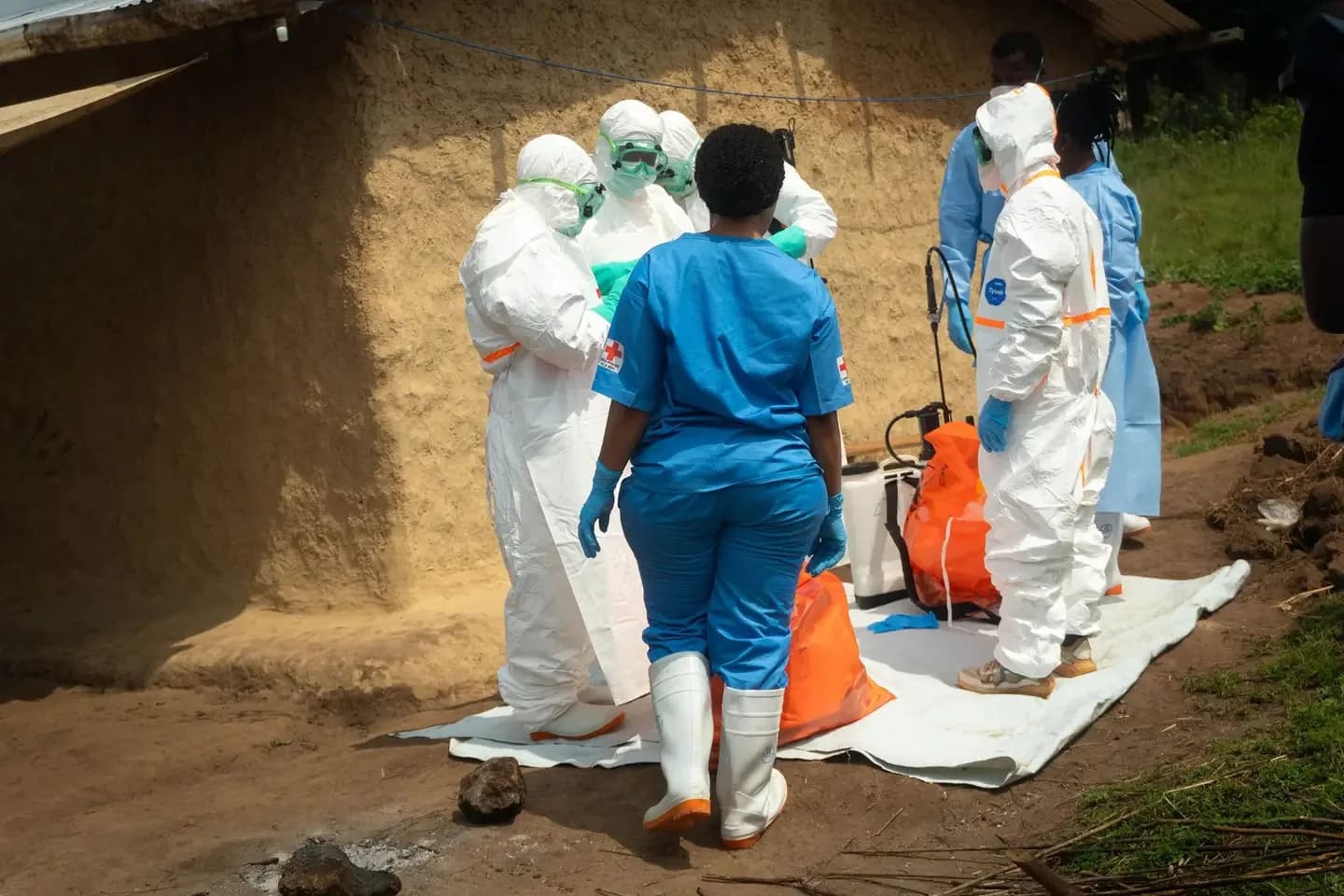
The head of the World Health Organization appealed for peace on Sunday after heavy fighting near a hospital in the Democratic Republic of Congo disrupted the response to an Ebola outbreak that has killed nearly 5,700 people. WHO Director-General Tedros Adhanom Ghebreyesus said health workers and aid partners had been forced to shelter inside a maternity ward for more than 24 hours, and he warned that patients, families and health workers were at grave risk.
"Heavy fighting has been ongoing since yesterday in the vicinity of a hospital in Ituri, in an area close to where the Ebola outbreak first emerged," Tedros wrote on X. "The situation has disrupted the work of the hospital and the wider Ebola response." He added that the WHO was working to arrange a safe exit for the team and for the hospital facilities, staff and patients to be protected. "The best medicine is peace," he wrote.
Tedros said the frequency of attacks across the east of the country had increased since the end of October, and that the violence was seriously affecting the Ebola response. The appeal, reported by AFP from Geneva on 22 November, came as the outbreak entered its seventh month.
An outbreak that keeps growing
The outbreak is caused by the Bundibugyo virus, a form of Ebola disease. It was confirmed on 15 May 2026 after an alert about a high-mortality outbreak in Mongbwalu health zone in Ituri province, and the WHO declared it a public health emergency of international concern on 17 May. It is now the largest and deadliest Ebola outbreak ever reported in the Democratic Republic of Congo.
As of 17 November, the WHO reported 11,613 cases and 5,678 deaths in the country. The WHO's weekly external situation report, with data to 7 November, recorded 10,920 confirmed cases and 5,323 confirmed deaths, a case fatality ratio of 48.7 percent, across 67 health zones in eight provinces. The European Centre for Disease Prevention and Control, using data to 16 November, reported 11,504 confirmed cases and 5,630 deaths, a slightly lower count that reflects the different reporting dates.
Ituri province remains the most affected area, accounting for about 70 percent of all confirmed cases. Nord-Kivu is the second most affected province, followed by Haut-Uele.
Children and health workers
The outbreak has hit children hard. UNICEF reported on 13 November that, using data to 4 November, 2,959 children were among the confirmed cases, or 28 percent of the total, including 1,737 deaths. Among children under five with confirmed infection, 72 percent had died. Health workers have also been among the victims: the outbreak alert in May followed four health worker deaths within four days in Mongbwalu, and on 4 November a health worker supporting the response tested positive and was medically evacuated to the United Kingdom for treatment.
Contact tracing, the work of finding and following people who may have been exposed, remains difficult. The WHO reported a contact follow-up rate of 86 percent as of 3 November, below its target of 95 percent, with population movement and continuing conflict cited as the main obstacles. Modelling cited in official situation reports suggests substantial undercounting, with the true number of infections possibly three to four times higher than the confirmed count.
Spread beyond Congo
The outbreak has crossed borders in a limited way. As of early November, Kenya had reported nine confirmed cases, including two deaths, and Nigeria had reported one confirmed case in a person who had travelled from Uganda. The WHO has advised countries not to close borders or place restrictions on travel and trade in response to the outbreak, and it assesses the risk as very high in the Democratic Republic of Congo, high in countries sharing land borders with it, and low elsewhere in the African region and globally.
The fighting in Ituri now threatens the response itself. Hospitals in the outbreak zone treat Ebola patients and ordinary patients at the same time, and when fighting reaches a hospital, both kinds of care stop. Staff who shelter in a maternity ward cannot run isolation units, trace contacts, or vaccinate. The WHO's appeal for peace was therefore aimed at the fighting as much as at the virus: without a halt to the attacks, the response cannot reach the people it is meant to protect.
Tedros did not name the armed groups involved in the fighting near the hospital, and the WHO has not published the name of the hospital. The organisation said it was working to arrange a safe exit for the team and protection for the hospital, its staff and its patients. The next situation report will show whether the fighting eased and whether case numbers in Ituri began to fall.