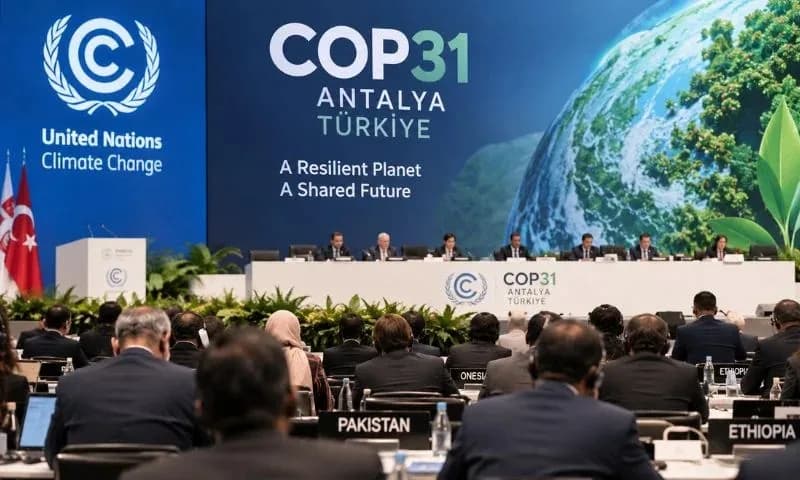
The COP31 climate summit in Antalya, Türkiye, ended on Sunday 22 November 2026 without a climate pact. After two weeks of negotiations and two days of overtime talks, governments failed to reach consensus on a final text, and the draft Antalya Pact has no formal standing. It was the longest UN climate summit on record. The question is whether the failure was a bad fortnight or a sign that the way climate talks work has stopped working.
The breaking point was fossil fuels. Disagreement over fossil fuel language proved the main obstacle, UN News reported. The draft text did not mention fossil fuels or a transition away from them. The European Union, Panama and the Marshall Islands formally objected. The EU said it could not accept a text omitting any reference to fossil fuels, calling the omission "unconscionable". Panama argued that governments had a responsibility "not to negotiate the minimum threshold, but to act". The Marshall Islands warned that accepting the text would amount to a betrayal of its people.
A text nobody wanted to defend
On the other side, the countries that opposed fossil fuel language were equally firm. Saudi Arabia, speaking for the League of Arab States, defended references to carbon capture and storage. Russia's delegate, Sergei Kononuchenko, said he could not agree "to any formulation on fossil fuel", according to Reuters. China called the lack of consensus a "deep disappointment" through delegation head Li Gao.
COP31 President Murat Kurum, Türkiye's environment minister, acknowledged the impasse at the closing plenary. "I understand that there is no agreement on this text. For that reason, these decisions have not been adopted," he said. Compromise drafts from the co-presidents, Australia and Türkiye, tried to win consensus. None of them held.
UN Secretary-General António Guterres said he was "deeply disappointed" by the outcome. "There may be no consensus in the negotiating room. There is no ambiguity in the science," he said. He warned that temperatures keep breaking records while the world is on course to exceed the 1.5°C limit agreed in Paris. "We can't put out the fire while pouring fuel on it," he said.
Why consensus keeps failing
The deeper problem is structural. UN climate talks decide by consensus, which means any one of nearly 200 governments can block a text. That rule was designed to protect small states from being outvoted. In Antalya it protected the opposite interest: fossil fuel exporters held the outcome hostage.
At COP28 in Dubai, governments agreed to transition away from fossil fuels. COP31 was supposed to build on that commitment. Instead, the final draft did not even repeat it. The World Resources Institute called the outcome "a failure of political leadership, not a failure of the Paris Agreement". The Paris Agreement survived Antalya, but the summit as a decision-making machine did not produce a decision.
The United States was not part of the effort. Under President Donald Trump, the US has pulled out of international climate action, CNN reported. Its absence removed the world's largest economy from the room and removed pressure on other large emitters to move.
What survives, and what does not
Not everything in Antalya failed. UN Climate Change Executive Secretary Simon Stiell pointed to an agreement on a just transition and initiatives under the COP31 Action Agenda. The presidency's push to accelerate electrification by 35% had backing from more than 70 countries, according to the World Resources Institute, even though it was excluded from any negotiated outcome. That record cuts two ways: clean energy work continues outside the negotiating room, but the summit itself is becoming less relevant to it. If the real measure of progress is whether countries cut fossil fuel dependence and expand clean energy, as Guterres put it, then a summit that cannot agree on any of those things is a stage, not a lever.
The choice before COP32
Three paths are open. One is to keep the consensus rule and accept that some summits will end with nothing, while progress happens through smaller coalitions and national policy. Another is to change the rules so that a large majority can adopt decisions over the objections of a few, a step vulnerable countries have long resisted because it could also be used against them. A third is to lower the ambition of the summit itself, treating it as a forum for pledges.
None of these paths is painless, and none is likely to be chosen quickly. But Antalya has made the choice unavoidable. A process that produces the longest summit in history and no agreement cannot simply be repeated at COP32 in Addis Ababa. Something else has to change — the rules, the ambition, or the belief that one room of nearly 200 governments can still decide the future of the climate.