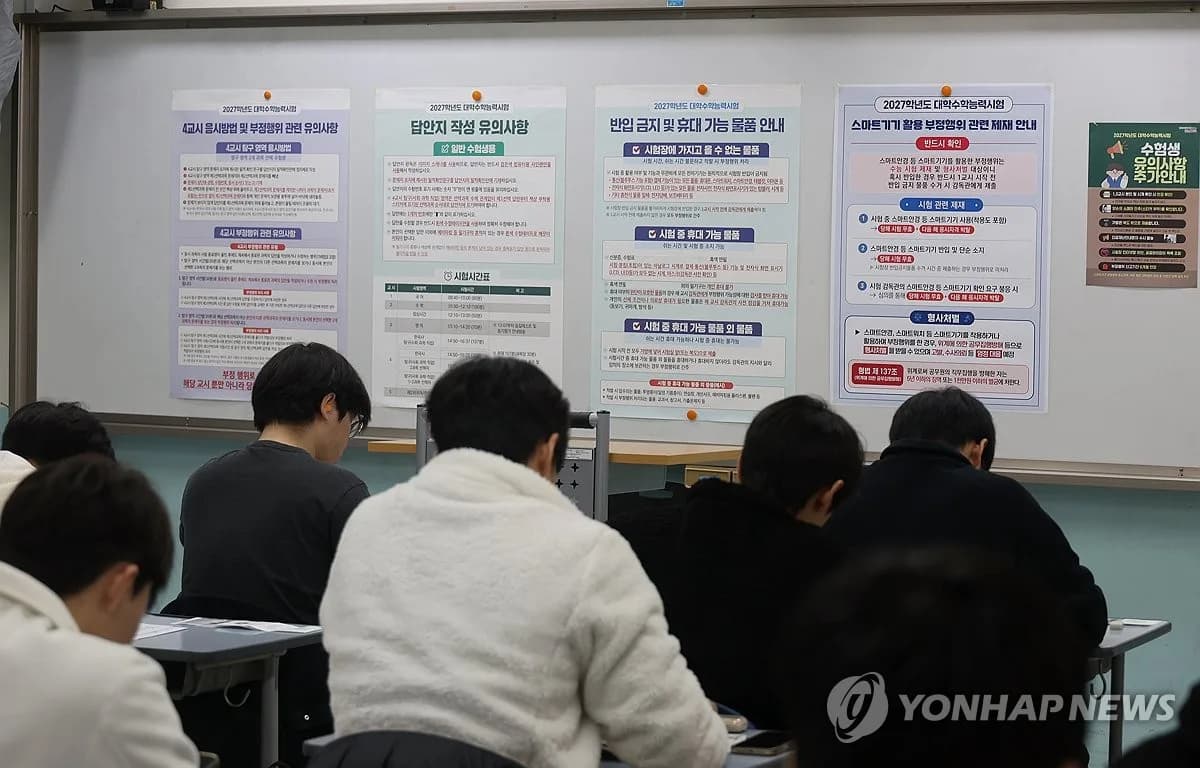
South Korea's education minister, Choi Kyo-jin, resigned on Sunday 22 November 2026, taking responsibility for confusion caused by last-minute measures to stop AI-assisted cheating in the country's college entrance examination. President Lee Jae Myung accepted the resignation within an hour and ordered a comprehensive review of national exam management and related laws. The episode exposes a problem larger than one minister or one exam: the test itself was designed for a world of hidden notes and whispered answers, before a camera the size of a button could send a question to artificial intelligence.
The College Scholastic Ability Test, known as the Suneung, was held on Thursday 19 November. More than 550,000 students registered for the eight-hour examination, which plays a major role in admission to South Korea's top universities. In the days before the test, the government rushed out tighter restrictions after the top scorer in a national tax-accountant examination admitted using a miniature camera, a smartphone and artificial intelligence to cheat. The confession came four days before the Suneung.
A confession that changed the rules midweek
The top scorer photographed questions with a miniature camera, sent the images to generative artificial intelligence software, and read the answers on a smartphone. He answered 159 of 160 multiple-choice questions correctly in the first round, according to Aju Press, and his passing certificate was later invalidated.
The education ministry had initially focused its preparations on smart glasses. After the confession on 15 November, it added emergency measures: public Wi-Fi was restricted around examination centres, proctors checked glasses and clothing buttons for hidden devices, and about 8,400 additional staff were deployed, according to Aju Press.
The measures worked as detection, but they also created the confusion that cost Choi his job. Rules changed until days before the exam, leaving students, parents and administrators unsure what was allowed. Choi acknowledged that inadequate preparation and repeated rule changes had inconvenienced students and officials. He also faced criticism after telling a parliamentary hearing on 16 November that he did not think he could detect AI-assisted cheating.
What the numbers actually show
Officials detected 111 suspected cases of cheating with electronic devices during the examination, the education ministry said. The 111 cases are a small share of more than 550,000 candidates, but the figure measures what was caught, not what was attempted.
That gap is the central problem. AI-assisted cheating breaks the old assumption that cheating is visible. The camera can be anywhere, the answer can arrive from outside the room, and the student need only read a screen.
President Lee wrote on X after the resignation that concerns over cheating using AI were spreading beyond the Suneung to essay-based admission exams and school tests, according to the Korea JoongAng Daily. "The fairness of exams is a principle that can never be compromised," he wrote. The practical question is harder: how does a country run a fair exam when the technology for cheating is cheap, small and widely available?
Detection is a race the examiners keep losing
The usual responses fall into two groups. One is stricter detection: more proctors, more scanning, more restrictions on what candidates can wear and carry. The other is redesigning assessment so that memorised answers matter less — open-book questions, oral examinations, coursework assessed over time, and tests that ask candidates to apply knowledge rather than recall it.
South Korea's experience suggests the first approach has a limit. The government deployed thousands of extra staff and still recorded 111 cases, and the measures themselves became a source of public anger. A system that treats every candidate as a suspect also carries a cost: stress for students, disruption for schools, and a political price for the officials in charge.
The second approach is slower and more disruptive. Changing how a national exam works means changing what schools teach, how universities select students, and what parents expect. The review Lee ordered will have to weigh that disruption against the risk of running the same exam again next year with the same vulnerabilities.
The test itself needs redesigning
Choi took responsibility for the preparation failures in his resignation statement. But an exam that ends without a major incident is not the same as an exam that is secure. The 111 detected cases, the last-minute rule changes and the minister's resignation all point to a system reacting to technology rather than anticipating it.
Any country that runs high-stakes written examinations faces the same pressure, and the tools for AI-assisted cheating will only get smaller and cheaper. The lesson of the Suneung is that protecting an exam now requires more than guarding the room. It requires asking whether the exam itself still measures what it claims to measure — and being willing to change it if the answer is no.