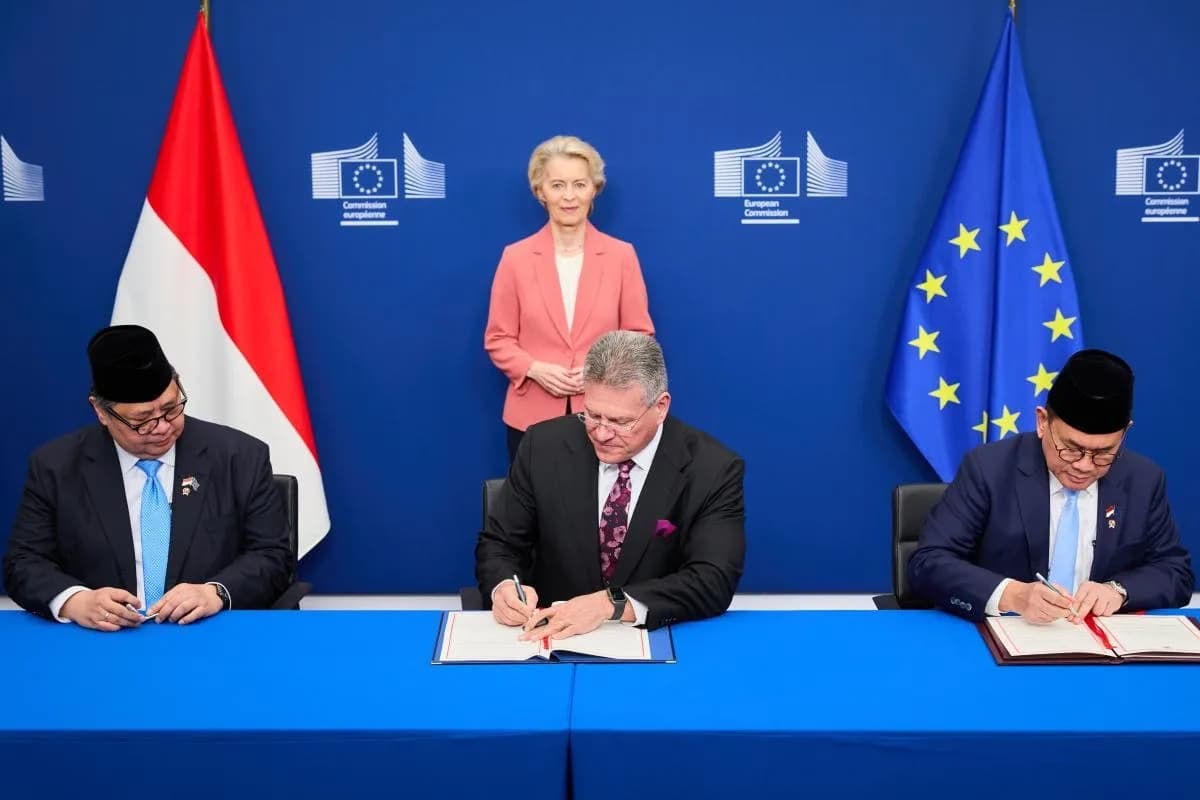
The European Union and Indonesia signed two agreements in Brussels on Saturday, 21 November 2026, closing almost ten years of negotiations that began in July 2016. The Comprehensive Economic Partnership Agreement, known as CEPA, covers trade and market access, and a separate Investment Protection Agreement covers safeguards for investors on both sides.
The deal will remove duties on 98.5 percent of Indonesian tariff lines for EU goods once implementation is complete. For Indonesian exporters, 90.4 percent of tariff lines will enjoy zero tariffs from day one, and a further 8.37 percent will be phased out over three to 15 years or through tariff rate quotas, according to Indonesian Coordinating Minister for Economic Affairs Airlangga Hartarto.
European Commission President Ursula von der Leyen attended the signing ceremony. Trade and Economic Security Commissioner Maros Sefcovic and Indonesian Trade Minister Budi Santoso signed the CEPA. Von der Leyen said EU-Indonesia trade and investment had vast untapped potential.
What the deal removes
The European Commission estimates that European businesses could save more than 600 million euros a year in customs duties once the tariff cuts take effect. Duties on main EU export products, including meat and dairy, will be removed, while tariffs on cars, machinery, chemicals and pharmaceuticals will be cut.
The Commission projects that EU exports to Indonesia could rise by almost 40 percent over 15 years. It also projects that the agreement will leave EU gross domestic product 16 billion euros higher and Indonesia's 27 billion euros higher.
For Indonesia, the preferential access is expected to make exports more competitive in the European market, particularly footwear, textiles and processed commodities. The agreement also covers services, digital trade and e-commerce, and investment in priority sectors such as electric vehicles, renewable energy and electronics.
A deal that still needs approval
Signature is a milestone, not the end of the process. The agreements require consent from the European Parliament and ratification in Indonesia before they can enter into force. Both sides are targeting provisional application in early 2027, with 1 January 2027 as the date businesses are working toward.
The timetable matters because Indonesia loses its preferential EU tariffs under the Generalised Scheme of Preferences on 1 January 2027. Airlangga said Indonesia's domestic process was already complete and waiting only for the signing, and that the government would prepare ratification soon after.
Negotiations on the agreement were finalised on 23 September 2025, after they were launched in July 2016. The EU Council authorised signature on 18 November 2026, three days before the ceremony in Brussels.
Why it matters now
The deal gives manufacturers on both sides stable, predictable access to critical resources, the Commission said, strengthening the trading bloc's supply chain against shocks. For Europe, Indonesia is Southeast Asia's largest economy and the world's fourth most populous country, with about 28.9 billion euros in EU-Indonesia trade value in 2025.
For Indonesia, the agreement is its most comprehensive trade agreement, covering market liberalisation, digital trade, investment flows and the facilitation of trade in services. Airlangga said the deal would create new jobs and that its benefits for exporters were concrete and measurable.
The next test is political. The European Parliament must give its consent, and Indonesia must complete ratification. Until those steps are done, the tariff cuts and the savings the Commission has projected remain estimates rather than facts on the ground.