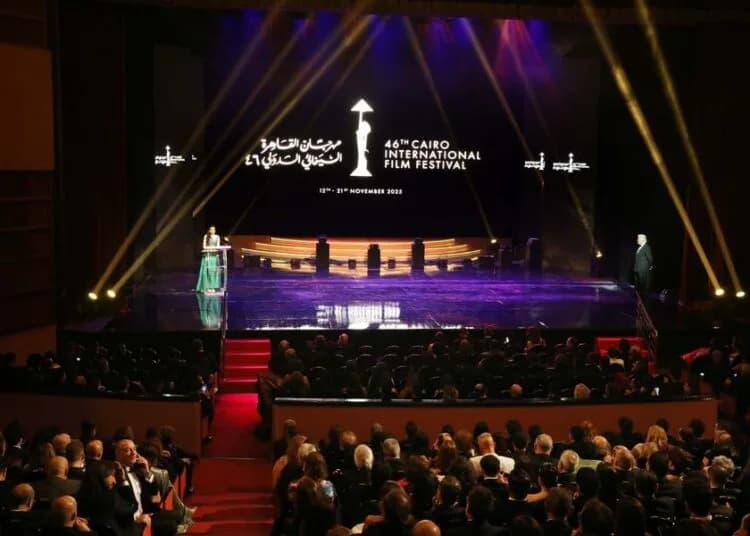
Adrian Goiginger's Four Minus Three won the Golden Pyramid for best film at the 47th Cairo International Film Festival, which closed on Friday 20 November 2026 at the Cairo Opera House. The Austrian-German drama took three awards in the international competition, including best actress for Valerie Pachner and best supporting actor for Robert Stadlober, in a closing ceremony that marked 50 years since the festival's first edition in 1976.
The film, which premiered at the Berlinale, follows a woman working as a professional clown who, after losing her family in a car crash, struggles to maintain her belief in laughter. The international jury, chaired by Moroccan filmmaker Nabil Ayouch, praised the power of its performances and the intelligence of its structure.
The Golden Pyramid carries a cash prize of $7,000. The award was announced at the closing ceremony by the international jury, in front of an audience that had spent ten days watching films across the Egyptian capital.
A festival that looked outward and inward
The rest of the international competition spread its prizes widely. French filmmaker Rudi Rosenberg won the Silver Pyramid for best director for Words Of Love, a film about a young girl's attempts to connect with her absent father that premiered in Un Certain Regard at Cannes. The Bronze Pyramid went to Dutch-Egyptian filmmaker Ashgan El-Hamus for her debut feature, Al Baraneya. Her father, actor Sabri Saad El Hamus, accepted the award on her behalf, explaining that she was unable to attend because she was caring for her three-week-old baby boy.
The Naguib Mahfouz Award for Best Screenplay went to Laïla Marrakchi and Delphine Agut for Strawberries, which is Morocco's submission to the Oscars. The film is about seasonal workers in southern Spain, according to FilmBunch.
Teodora Ana Mihai's Heysel 85, about the football stadium disaster in which 39 people lost their lives, also received three awards. Cinematographer Marius Panduru and production designer Hendrik Van Kets each won a Henry Barakat award for best artistic contribution, and the film won the FIPRESCI critics' prize.
Arab cinema took the largest share of the night
The Horizons of Arab Cinema competition gave its main award to Rania Rafei's The Day Of Wrath: Tales From Tripoli, which was also named the festival's best documentary. The Salah Abu Seif special jury prize went to Your Daughter, directed by Sara Shazli.
A further triple winner was Summer Meadow, directed by Naël Khleifi and Lisa Debauche. It won best Arab film, best acting performance for Manal Issa and the best screenplay or creative achievement award, shared with Mohamed Zineddaine's Until Dawn. The film follows a Lebanese woman training as a shepherd in isolation in the French Alps, according to FilmBunch.
In the Critics' Week section, the Shadi Abdel Salam award for best film went to The River Train, by Argentine filmmakers Lorenzo Ferro and Lucas A. Vignale. The Youssef Chahine Award for Best Short Film went to Our Secrets by Lenti Liang. The audience award, the Youssef Cherif Rizkallah Award, went to BerleeN_ by Egyptian filmmaker Ahmad Abdalla, chosen by audience vote.
Veteran Egyptian cinematographer Said Shimi was honoured with the festival's Golden Pyramid for lifetime achievement, recognising his longstanding contribution to Egyptian cinema. Reflecting on his career, Shimi spoke about his work with around 40 filmmakers and paid tribute to his long-standing friendship and professional relationship with filmmaker Mohamed Khan. "We dreamed about cinema together," he recalled.
Fifty years on, a festival still growing
In his closing address, festival president Hussein Fahmy said ticket sales of around 53,000 had been recorded for this year's 50th anniversary edition, with further screenings still to be counted. The figure suggests a festival that has kept its audience even as the market for arthouse cinema has narrowed in many countries. Cairo's position as the Arab world's oldest film festival — it held its first edition in 1976 — gives it a reach that newer festivals cannot easily match: it can programme European arthouse alongside Arab cinema and draw audiences for both.
The winners' list reflects that balance. Four Minus Three is a European film about grief, premiered in Berlin. Summer Meadow and The Day Of Wrath are Arab films about work, isolation and war. The jury rewarded all of them, and the audience award went to an Egyptian film.
That mix is the festival's argument for itself. Fifty years after its first edition, Cairo remains a place where a clown's grief, a shepherd's solitude and a stadium disaster can share one stage — and where 53,000 tickets can still be sold for films that most cinemas would not show.